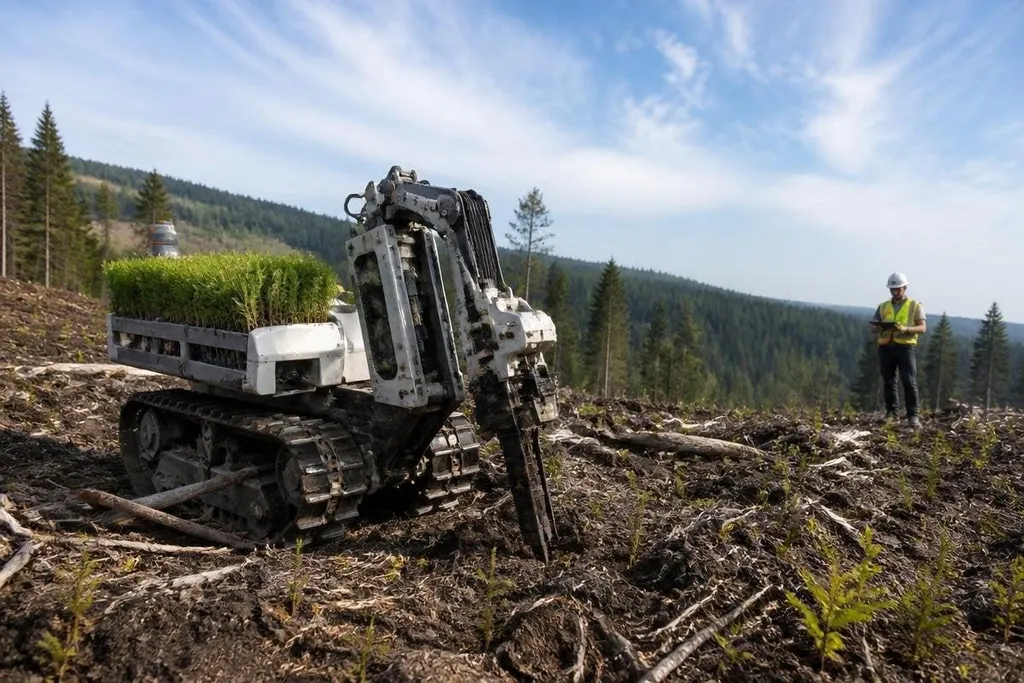
A reforestation robot has a hard job: place living trees in rough ground, find them again, and work without constant human control. The machines worth watching will prove those tasks across real planting sites, not only on prepared soil.
If you work in forestry or land restoration, the useful question is practical: can a robot lower planting effort while keeping seedlings alive?
- Planting quality: The robot must place each seedling at a repeatable depth and angle.
- Terrain handling: It must move across slopes, rocks, loose soil, and fallen branches.
- Field records: Every planting point should carry a location, time, species, and status.
Planting is only the first test
A planting arm can dig a hole, place a seedling, and close the soil. That sequence sounds short, but each step affects survival. A shallow hole can expose roots, while packed soil can block water and air.
The useful design will combine a planting tool with machine vision, location data, and a way to check the soil before the arm starts. A camera can spot open ground. A soil sensor can identify moisture near the planting point. A positioning system can record the exact place for later care.
That record matters after the robot leaves. Forestry teams need to know which seedlings were planted, where gaps remain, and which areas need water or protection. A robot that plants quickly but leaves poor records can add work instead of cutting it.
The ground will decide what works
Forest sites are rarely clean fields. Grass, roots, stones, mud, and steep slopes all change how a mobile robot moves. Wheel-based systems may work well on firm tracks, while tracked or legged designs may handle ground that would stop a small wheeled vehicle.
The choice also affects soil damage. A heavy robot can compact wet ground around young plants, making later growth harder. A lighter robot may carry fewer seedlings and need more trips.
Field trials need to report machine weight, planting rate, slope limits, and the soil conditions during each run.
Autonomous movement brings another test. The robot must stop when a person enters its work area, detect an obstacle, and return safely after losing its position signal. Geofencing can keep it inside a mapped boundary, but that boundary still needs checks when trees fall or access routes change.
Robots need work after planting
Planting has a clear moment of success, but reforestation takes years. A useful system could return to inspect seedlings with cameras, measure plant height, and mark dead or missing trees for a later visit.
That creates a wider role for autonomous systems. The same vehicle might carry a camera one week and a watering tank another week, but the change only helps if the frame, power system, and software support those jobs without long repair stops.
A field-trial report should name the machine, test site, date, and measured result. Robot24.com reforestation coverage can help you compare those details with claims about new forestry machines, before the next check asks how many planted trees survive.
The open gap is survival data. A planting demo can show an arm placing a seedling in soil. It cannot show survival after drought, frost, animals, or competing vegetation unless the team returns to measure the site.
What a serious field trial should report
A buyer should ask for the same details from every maker. Video helps, but written field records tell you far more about the cost and limits.
- Site conditions: Record slope, soil type, weather, vegetation, and access routes.
- Machine load: State the robot’s weight, battery size, seedling capacity, and refill time.
- Planting output: Report trees per hour, failed placements, and human hours per hectare.
- Safety results: List emergency stops, obstacle detection failures, and remote-control use.
- Follow-up data: Measure seedling survival at fixed dates after planting.
- Repair needs: Count blocked tools, damaged parts, software faults, and recovery time.
The buying test
Before you approve a trial, ask the team to define the land area, tree species, planting season, and staffing plan. Then set a clear comparison with manual planting on the same site, since a robot's speed means little if it needs more people to watch and refill it.
Check how the system handles the work between planting runs. A machine that needs a technician on site for every fault may fit a research project but struggle in a remote forest. Spare parts, training, satellite coverage, and transport can matter as much as the arm.
I'd skip any system that reports planting speed without seedling survival and human labour figures. Those are the numbers that decide if the machine helps a forestry team.
The next useful proof will come from repeated seasons on the same kind of land. Until makers publish planting output, repair time, labour needs, and survival data together, reforestation robotics remains a field trial rather than a purchase decision.